The 4 Ps of Marketing: Complete Guide with Examples
Master the 4 Ps of marketing — product, price, place, promotion. See real marketing mix examples, learn the 7 Ps, and apply the framework to your brand ...
The 4 Ps of Marketing: Complete Guide with Examples
Key Facts
- The 4 Ps of marketing, product, price, place, promotion, were first published by E. Jerome McCarthy in 1960, per Investopedia.
- Marketers now work across an average of 10 channels, and 85% say customer expectations are higher than ever, Salesforce research finds.
- 75% of marketing organizations use at least one form of marketing AI, yet 69% still struggle to respond to customer inquiries fast enough, according to Salesforce.
- One founder who spent 6 months building an unused product advises: spend twice as much time marketing as building, per Reddit's r/smallbusiness.
- The 7 Ps framework added People, Process, and Physical Evidence in 1981 to cover service businesses, Professional Academy explains.
- A jewelry brand raised necklace prices from $18 to $32–$48, proving price signals quality and repositioning items as everyday luxury, Forbes Advisor reports.
- All four Ps must align, if price matches product value and customer needs, marketing resonates and converts, Asana's guide states.
Why Most Marketing Fails: Your Ps Are Out of Sync
Most marketing doesn't fail because the ads were bad. It fails because the pieces underneath the ads don't agree with each other.
The product is solid, the price feels fair, but you're promoting it in the wrong channels, or you've priced a premium product like a commodity. When product, price, place, and promotion pull in different directions, even great creative can't save the campaign. As Asana's guide to the 4 Ps puts it, all four Ps must align: if your price matches product value and customer needs, your marketing will resonate and convert. If they don't, it won't.
The problem is that most founders never check for alignment, because they never spend enough time on marketing in the first place. A widely shared post on Reddit's r/smallbusiness captured this bluntly after a founder spent six months building a web product nobody used: "Always spend twice as much time marketing as you do building. You will not get users if they don't know it exists." The same post urged founders to define success metrics before launching, and to rethink the whole idea if people aren't excited enough to pay in advance.
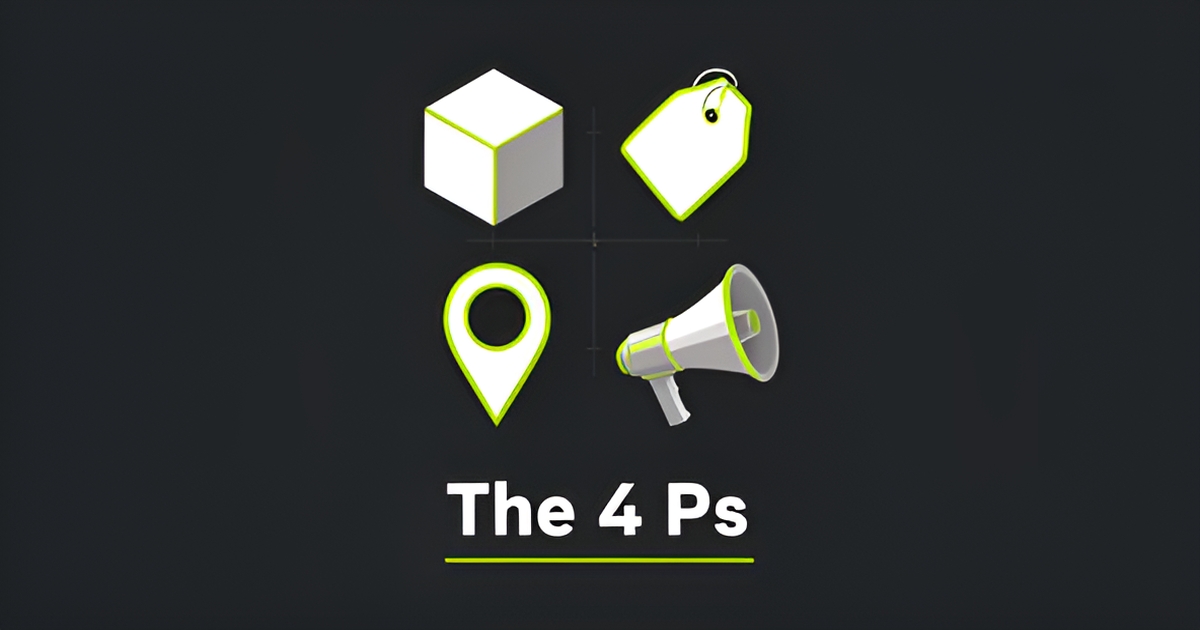
That's where the 4 Ps of marketing come in. They're the four decision areas that make up your marketing mix:
- Product, what you sell and the need it solves
- Price, what customers pay and what that says about your positioning
- Place, where buyers find and buy from you
- Promotion, how you communicate the offer
The framework has serious pedigree. Neil Borden, a Harvard advertising professor, popularized the term "marketing mix" in the 1950s, according to the American Marketing Association. Then in 1960, marketing professor E. Jerome McCarthy refined the mix into the four Ps in his book Basic Marketing: A Managerial Approach, as Investopedia documents. Later thinkers like Philip Kotler carried the framework into mainstream marketing education, and it's still the backbone of marketing mix strategy today, even as it's been extended into the 7 Ps of marketing for service businesses.
What's changed is execution, not strategy. "Place" now means online platforms beyond storefronts. Promotion now runs through social media, email, and search ads. Marketers work across an average of 10 channels, and 85% agree customer expectations are higher than ever, per Salesforce's research. More channels means more ways for your Ps to drift out of sync.
At Worqd, we see this constantly: a client's offer is fine, but the pricing, channels, and messaging were never audited against each other before spending started. The fix is rarely more budget. It's alignment first, then scale.
The 4 Ps of marketing, product, price, place, and promotion, form the essential architecture behind every successful campaign. First formalized by E. Jerome McCarthy in 1960, this framework endures because it forces marketers to confront the four levers that determine whether a product thrives or gathers dust. However, the digital era has reshaped how each P is executed. "Place" now describes online platforms rather than solely brick-and-mortar shelves, and "promotion" spans social media, email, and search ads. Critically, 85% of Fortune 100 companies rely on Asana to coordinate these elements, and modern marketers navigate an average of 10 channels to reach their audiences.
Product: Positioning Features Around Customer Problems
The product pillar asks what you are selling and, more importantly, why customers should care. Too often, brands list technical specifications and expect value to follow. A more effective approach highlights the specific benefits that resolve real pain points. Asana’s research emphasizes that marketing connects a product to a target audience by showing how it delivers better results, speed, or price. For example, rather than simply listing a feature, a company might spotlight the unique safety mechanisms that address parents' concerns about young children. This shifts the conversation from what the product is to what the customer gains.
Price: Pricing to Perceived Value
Price determines more than revenue; it shapes market positioning. The strategy sits on two pillars: covering production costs and reflecting perceived value. Brands must decide whether their offering occupies the budget tier or the premium space. Forbes Advisor highlights a telling case study: jewelry necklaces initially benchmarked at $18 against Etsy competitors were repriced between $32 and $48. This adjustment reflected the shift to gold-filled materials and repositioned the items as "everyday luxury." The lesson is clear, price signals quality. If a brand prices too low, it risks undermining perceived value; price too high without corresponding quality, and conversion stalls.
Place: Matching Channels to Demographics
Place addresses distribution and visibility. In the digital age, this means ensuring the product is available where the target audience shops. The Asana data drives home a critical demographic mismatch: promoting a premium product to Gen Z via Facebook ads is often ineffective. This generation’s online behavior favors different platforms and formats. Furthermore, CIM notes that e-commerce operations must prioritize the company website and digital touchpoints, as customers have fewer physical interaction points. The goal is meeting the buyer exactly where they already spend time, rather than forcing them to adapt to the brand’s preferred channel.
Promotion: Benefits Over Features
The final P, promotion, is the communication bridge between product and customer. Effective promotion does more than broadcast features; it communicates the tangible benefits the customer receives. The Chartered Institute of Marketing (CIM) reinforces this, stating that promotion should highlight received benefits rather than a list of features. Luna & Stone’s jewelry business exemplifies this shift. By streamlining 40+ inconsistent styles into a curated bestseller collection, the brand clarified its message and saw improved resonance. Promotion that answers "what's in it for me?" converts browsers into buyers far more effectively than feature lists ever could.
The evolution of the framework continues with the 7 Ps, adding people, process, and physical evidence, particularly for service-based businesses where trust and delivery quality are paramount. Yet the original 4 Ps remain the strategic backbone. As the research confirms, these four elements work best when aligned: if price reflects product value and distribution reaches the intended audience, promotional efforts resonate and convert. For brands ready to audit their own mix, Worqd’s marketing strategy templates offer a practical framework to apply these principles directly.
When 4 Ps Aren't Enough: The 7 Ps of Marketing
Here's the honest truth about the 4 Ps: they were built for selling physical products, and they don't always cover what matters most today. As Asana's marketing guide points out, the framework doesn't always address factors like customer experience, service delivery, or the growing role of trust in online marketing. If you run a service business, you already know why. When a customer is standing in front of the person delivering the service, the delivery itself becomes part of what they're paying for.
That gap is what led to the 7 Ps of marketing. In 1981, Booms and Bitner extended the classic marketing mix with three additional elements designed specifically for service businesses:
- People - everyone involved in delivering the service. Having the right people is essential, because they're as much a part of your offering as the product or service itself.
- Process - how the service gets delivered. A smooth, well-mapped customer journey is part of the value, more than an operational detail.
- Physical evidence - the tangible proof that makes an intangible service feel real: your website, packaging, testimonials, even the space where the service happens.
Physical evidence matters more than it sounds. Even when nothing is printed, the customer is still receiving something physical by this definition - a well-designed site, a confirmation email, a case study. These touchpoints reduce the uncertainty buyers feel when they can't see or touch what they're purchasing. The 7 Ps framework gives service-based businesses and brands focused on customer loyalty a more complete marketing mix.
A couple of other alternatives are worth knowing. The 5 Ps keeps the original four and adds "people," placing greater emphasis on customer interaction and experience. The 5 Cs - customer, company, competition, collaborators, and climate - flips the lens entirely, focusing on the external forces shaping your marketing mix strategy rather than your internal decisions.
There's one more critique worth sitting with. Forbes Advisor expert Meghan Doucette argues the 4 Ps model "doesn't fully reflect modern marketing - branding is a major missing piece." She notes the framework is rarely discussed outside academic contexts, while founder-led, authentic personal branding keeps growing as a trend she expects to strengthen. That tracks with what we see at Worqd: buyers increasingly decide based on who they trust, and trust is built through consistent experience and follow-up, more than a well-priced product on the right shelf.
The practical takeaway: use the 4 Ps of marketing as your strategic backbone, then layer in the 7 Ps if you sell services, and treat branding as the connective tissue across all of it. The framework still sets the strategy - what's changed is how much of the buying decision happens through experience and trust rather than the transaction itself.
How to Apply the 4 Ps to Your Business Today
Knowing the 4 Ps is one thing. Using them to make better decisions this week is another. Here's how to turn the framework into action before you spend another dollar on ads or creative.
Start with a cross-P audit. Before any launch, check that all four Ps actually agree with each other. Does your price match the value your product claims to deliver? Do your channels reach the people who'd actually pay that price? Does your promotion message match what the product really does? Research from Asana's marketing guide is blunt about this: if your price aligns with product value and customer needs, your marketing efforts resonate and convert. When one P is out of step, the whole campaign underperforms.
Ask yourself a few uncomfortable questions:
- Is my pricing a deliberate choice (premium or competitive), or a number I picked because it felt safe?
- Am I advertising where my buyers actually are? Different channels reach different demographics, and Facebook ads won't cut it if you're selling to Gen Z.
- Does my promotion sell benefits, or merely list features?
- If I'm a service business, have I considered the 7 Ps extension (People, Process, Physical Evidence) that Booms and Bitner added in 1981?
Next, set validation metrics before you spend. Small business owners who've been through this will tell you to define success metrics before you start, like "1,000 users in 3 months," and to seriously reconsider the project if you miss them. The same discipline applies to campaigns: decide what a win looks like (cost per lead, booked calls, reply rate) and give it a deadline. One founder's advice sums up the priority: spend twice as much time marketing as you do building, because nobody buys what they don't know exists.
Then there's execution. Here's where things get interesting. According to Salesforce's State of Marketing research, 75% of marketing organizations now use at least one form of marketing AI, yet 69% of marketers still struggle to respond to customer inquiries fast enough. That gap is the whole story. AI can write your ads and draft your emails, but it won't carry context forward or keep customer journeys moving on its own. As Salesforce puts it, the four Ps still set the strategy. What changes is execution.
That's the gap we built Worqd to close. One partner runs the whole path from first click to booked call: getting demand in the door, responding to every inquiry in under 60 seconds, and testing creative at the speed your media buying actually needs. The 4 Ps decide where you're going. Fast follow-up and constant testing decide whether you get there.
If you want to apply this to your own business, book a free growth call with Worqd. We'll walk through your marketing mix using our strategy templates, find the bottleneck, and map the fastest path from first click to booked call.
Frequently Asked Questions
What are the 4 Ps of marketing?
Why does my marketing fail even when the ads are good?
What's the difference between the 4 Ps and the 7 Ps of marketing?
Does the 4 Ps framework still work in the digital age?
How should I price my product as part of the marketing mix?
How do I actually apply the 4 Ps to my business?
Full article content will appear here once published.
)}Want help putting this into action?
Book a Growth Call