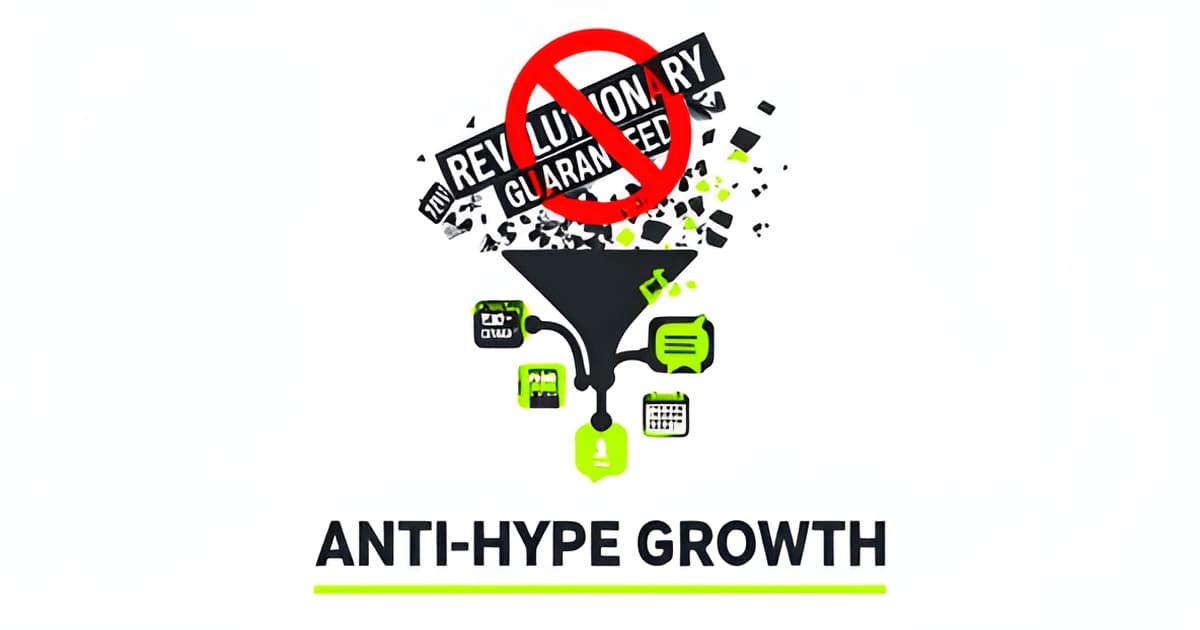
Most AI marketing companies can't wait to tell you they're revolutionary. Worqd would rather you never see that word in anything it publishes. The Halifax-based growth agency, operated by AIQ Labs, keeps a banned-words list that includes "10x," "guaranteed," "revolutionary," "game-changing," and "unlimited," and it pairs that list with a written anti-fabrication policy: no invented revenue numbers, no fake logos, no made-up testimonials. In a market soaked with AI hype, that stance is either a clever brand play or a genuine accountability mechanism. It might be both.
Key points
- Worqd sells a full growth path, from paid ads and creative to AI SDR follow-up and reactivating old CRM leads, rather than standalone software.
- The company claims its AI SDRs produce a 4-7x conversion lift over unmanaged follow-up and cut cost per qualified conversation by 70-80% versus a traditional SDR team; these figures are self-reported.
- An explicit anti-fabrication policy bans words like 'guaranteed' and 'revolutionary' and forbids inventing revenue figures, logos, or testimonials.
- Answer-engine optimization, getting cited inside ChatGPT, Perplexity, and Google AI Overviews, is tracked as its own metric, with a prove-it-on-ourselves-first rule.
- Pipeline recovery uses a risk-sharing model: you only pay for the conversations that come back from your existing database.
The core pitch at Worqd is simple: when you split ads, creative, SEO, and lead follow-up across separate vendors, each one optimizes its own slice and nobody owns the result. Worqd's answer is a retainer-style partnership that runs the whole path from first click to booked sales call, with one plan and one report. The service sits on seven pillars. Lead generation and demand generation bring buyers in through paid ads, SEO, and targeted outreach. An AI Creative Lab produces UGC-style video and static ads at media-buying speed, including white-label options for agencies. AI SDRs and voice agents answer and qualify every inquiry in under 60 seconds, around the clock, and can hand calls to a human with full context. Pipeline recovery reactivates the contacts already sitting in your CRM. A back-office automation pillar handles lead qualification, after-hours calls, support resolution, and document processing on the same systems that run the funnel. There are also two packaged offers. The Growth Engine follows a Build, Launch, Optimize, Recover sequence. The Creative Sprint turns one brief into 10 ad concepts with 3 hook variations each, up to 30 platform-ready videos for testing.
Worqd claims its AI SDRs deliver a 4-7x conversion lift over unmanaged follow-up, and a 70-80% lower cost per qualified conversation compared with a traditional SDR team. Every inquiry gets qualified in under a minute, including nights and weekends, which matters because slow response is where most businesses quietly lose deals. Those are company-reported figures, and Worqd itself acknowledges as much. Its anti-fabrication policy states that until real evidence is approved, the company uses clearly marked placeholders rather than dressed-up claims. That's an unusual posture. Most agencies publish their best numbers and hope nobody asks for the methodology. Worqd's approach effectively invites the question, which is either confidence or smart expectation-setting. Either way, a buyer evaluating the service should ask for the evidence behind the 4-7x claim on a growth call before signing anything.
The most interesting pillar might be AI Search Visibility, sometimes called AEO or GEO. When someone asks ChatGPT, Perplexity, or Google AI Overviews for a recommendation, some brands get cited and most don't. Worqd treats that citation presence as a distinct, tracked metric rather than a vague branding benefit. The company applies a standard worth noting: if it can't achieve answer-engine visibility for itself, it won't sell the service to you. Self-testing as a precondition for selling is rare in this space, where SEO shops have long resold tactics they've never validated on their own properties.
Pipeline recovery deserves its own mention because of how it's priced. Most agencies charge for activity. Worqd's database reactivation offer works differently: you pay only for the conversations that come back. The contacts already exist in your CRM, which means you already spent money acquiring them. Reactivation is an attempt to extract value from that sunk cost without forcing you to switch tools, since the service works with your existing CRM. That risk-sharing structure signals something about where the agency model is heading. When a vendor only gets paid when a dead lead revives, the vendor has to be selective about which reactivation campaigns it runs. It also gives buyers a cleaner test: if the offer doesn't work, you don't pay much for finding that out.
Worqd's compliance posture is unusually explicit for a growth agency. Its B2B outreach is described as personalized and permission-aware, aimed at relevant accounts, which the company contrasts with template blasts. The booking funnel requires an affirmative consent checkbox before contact details are used, and the analytics policy bars sensitive form fields from being sent to public analytics tools. For Canadian businesses this matters beyond good manners. CASL and PIPEDA both put real constraints on outbound messaging and data handling, and enforcement attention has grown as AI-generated outreach has scaled. An agency that builds consent into its funnel rather than bolting it on is easier to defend if a regulator ever comes asking.
Worqd says its lead generation applies to virtually every industry, B2B or B2C, local or national, from SaaS and MSPs to legal, dental, real estate, and home services. That breadth is a marketing claim like any other. Realistically, the strongest fit looks like tech-enabled service businesses, agencies that want white-label creative, and local service companies that need fast phone answering more than they need brand campaigns. If your sales motion doesn't involve a booked call, the model matters less to you. There's no public pricing. Work is scoped on a free growth call, and the booking funnel asks for your monthly marketing budget, from "not spending yet" to "$25,000+." That's a reasonable filter, but it also means you can't comparison-shop from the outside. Bring your numbers to the call and hold the conversation to Worqd's own standard: real evidence, clearly sourced, no placeholders dressed as proof.
Worqd is worth watching for two reasons. First, its integrated model attacks a real problem: fragmented vendors optimizing their own slices while nobody owns the pipeline. Second, its anti-fabrication policy is a genuine experiment in whether an AI services company can market itself without the vocabulary the rest of the industry leans on. The claims are self-reported, the pricing is opaque until you book a call, and the banned-words list is only as strong as the discipline behind it. But if the company holds itself to the standard it has written down, it may be selling the one thing buyers say they want most from AI marketing right now: fewer claims, more receipts.